
June 2024
The Ache
By Frank Diamond
As I drag our trash
To the edge of our drive
Orange streaks our dawn
In our fortunate sky
Two gamey deer just happen
To turn quizzically my way
Then on they bound just like — Snap!
What DO we talk about
When we DON’T talk about love?
Two cats bagged in canvas
Somehow getting on — but just
Time to decide which room
Needs a coat of paint today
And when the fumes finally settle
Our bickering takes a break
We tap water into the kettle
Never mentioning The Ache
But in that pause each clutches hope
“Please let me die fore this old dope.”
It’s Not Fair
By Frank Diamond
That I should awake each day
Dream-sliding on a bed of my own
And know three meals will be consumed
Washed down with water running through
Drive to my job. Get lost in my work.
Light a votive for my sleeping wife
Praise how she graces my existence
That I can walk in October woods
While leaves descend in tongues of fire
Or by the Atlantic on a summer’s eve
Feel eternity in the soles of my feet
I can laugh (what power!); sing in the shower
And down ice-dazzled beer on Friday nights
That my health so far, so good (knock wood)
Watch my daughter grow proud and strong
Savoring experiences that her path offers
I can read great books or gossip columns
Watch TV by the light of the fireplace
Cherish the beauty of women with proper respect
Find youth-light in the withered faces of the old
And wisdom in a toddler’s pronouncement
That I can stand awestruck in kiss-ling snow
Or listen to rain romancing the streets
Look up at the star-quilt from a country road
And praise all who have hallowed my journey
For vast legions of humanity dead and alive
Aren’t so blest. And it’s not fair! It’s not fair!
Biography
Frank Diamond’s poem, “Labor Day,” was nominated for a Pushcart Prize Award. His short stories have appeared in RavensPerch, the Examined Life Journal, Nzuri Journal of Coastline College, and the Fredericksburg Literary & Art Review, among many other publications. He has had poetry published in many publications.He lives in Langhorne, Pa.
The View From Wherever
By John Grey
I sit, rest my back against a rock,
look down at
the mountainside I’ve climbed
to the whisp of cloud,
so low in the sky, it seems lost,
and that stone scramble,
the hardy brush above the tree-line,
the odorous ponderosa,
the undulating aspen
and, beyond that,
the town in the valley,
scattered roofs
and a solitary church spire,
farm fields in green corduroy,
the bobbing heads of cattle,
and a tractor that stops
at the lowest point
in the terrain,
and its driver, whose face
is too far away to make out,
but is surely looking up
in my direction,
awed by the scenery,
acknowledging all that I see,
only in reverse.
Please Seek Alternative Routes
By John Grey
The roads in my neighborhood
are forever being dug up.
Some are reduced to one lane only.
Others are completely closed off to traffic.
It’s a little like those far-away anti-war days
when thoroughfares were blocked
by students wielding signs.
But instead of “Stop The War Now”,
these placards merely read, “Stop.”
Every bulldozer in the city’s armory
is out and about.
And, for every one of those asphalt eaters,
there’s at least two trucks to keep it company.
The work never ends.
Nor do the traffic jams.
I foresee a day when I leave my home
for a quick coffee and pastry at my favorite hangout,
and find myself prevented by closures in all directions
from ever reaching my apartment.
That’s the day when I turn my car around
and just keep driving
wherever there is a road that’s actually going someplace.
I may head north towards Canada,
although I’d have to pass through immigration.
It’s possible I wouldn’t be let through.
But, at least, I’d already know the feeling.
ER in Darkest December
By William Doreski
The clock’s so anxious its hands
tick backward in nervous jerks.
We arrived at two AM. Now
it’s one. For the first lost hour
your pain centered on itself,
but now it clouds the landscape
and troubles many bland sleeps.
The ER doctor looms and sighs.
His lime scrubs conceal him
from his family, friends, and dog.
He doesn’t remember meeting us
the other day as he walked his pet
in the little park by the river.
He knows us only as patient
and bystander, my usual role.
He diagnoses pain, not death,
and zooms on a kidney stone,
lithology and specific
gravity unknown. The pain
has abated. The clock still ticks
counterclockwise. The doctor
ignores this odd phenomenon,
busy writing a prescription
in that notorious scrawl
everyone learns in med school.
The IV throbs and coughs, pumping
a colorless painkilling blend.
When the doctor leaves, the cubical
sways like a crow’s nest. The wind
blows from deep inside the mind.
We look into each other’s eyes
to see weather gathers its forces
for the final, secret assault.
Biography
William Doreski lives in Peterborough, New Hampshire. He has taught at several colleges and universities. His most recent book of poetry is Venus, Jupiter (2023). His essays, poetry, fiction, and reviews have appeared in various journals.
Pad 39A Dragon Systems Are Go!
By Gerard Sarnat
Oy, speaking
past-Afrikaans
Wunderschoen
vulture capitalists
who launch SpaceX’s
carnival to thunderous
Canaveral weiß applause
know they’ve earned their lot
lighting Elon’s uber-infomercial
candle which attaches umbilicus-
of-the-privileged that may inflame
be-damned-rest-of-us left bereft here
on festering 🌏 to burn it all down now
despite those musky fat fingers of wealth
putting a usual thumb on scales of justice
while the richer-than-Gott against all odds
begin egress into elegant Tesla-on-steroids
gauge-knob-dial-switch-clue-less simplicity
to escape corporate wasteland in reusable craft.
Some crew puke going up, others splatting down.
Biography
Poet and aphorist Gerard Sarnat is widely published internationally in print and online. He has been nominated for the pending Science Fiction Poetry Association Dwarf Star Award, won San Francisco Poetry’s 2020 Contest, the Poetry in the Arts First Place Award plus the Dorfman Prize, and has been nominated for handfuls of Pushcarts plus Best of the Net Awards. Gerry’s publications include 2024 University of Idaho/Confluence Lab, 2023 San Diego Poetry Annual, 2022 Awakenings Review, 2022 Arts & Cultural Council of Bucks County Celebration, 2022 Rio Grande Valley International Poetry Festival Anthology, Antithesis, Magma, Ginosko, Chiron Review, WORDPEACE, Midwest Zen, Cordite Poetry Review, Young Ravens, Fjords, Turtle Island, MIPOesias, Ocotillo Review, Gravity of the Thing, American Writers Review/ San Fedele Press, San Francisco Creative Writing Institute, Israel Association of Writers in English, In Parentheses, Sacramento Review, Pocket Samovar, Black Sunflower, Free State, The Broken City, Sandy River Review, Three Rooms Press/Maintenant, New World Writing, Songs of Eretz, New Verse News,The Font, BigCityLit, HitchLit Review, Lowestoft, Washington Square Review, The Deronda Review, Jewish Writing Project, Hong Kong Review, Tokyo Poetry Journal, Buddhist Poetry Review, Gargoyle, Main Street Rag, New Delta Review, Arkansas Review, Hamilton-Stone Review, Northampton Review, New Haven Poetry Institute, Texas Review, Vonnegut Journal, Brooklyn Review, San Francisco Magazine, Monterey Poetry Review, The Los Angeles Review, and The New York Times as well as by Oberlin, Yale, NYU, Slippery Rock, Northwestern, Pomona, Brown, Harvard, Stanford, Dartmouth, Penn, Johns Hopkins, Columbia, Grinnell, North Dakota, Nebraska, McMaster, Maine, Universities of British Columbia and Toronto and Chicago and Virginia presses. He is a Harvard College and Medical School-trained physician who’s built and staffed clinics for the disenfranchised as well as a Stanford professor and healthcare CEO. Currently he is devoting energy/ resources to deal with climate justice, and serves on Climate Action Now’s board. Gerry’s been married since 1969 with progeny consisting of four collections (Homeless Chronicles: From Abraham To Burning Man, Disputes, 17s, Melting the Ice King) plus three kids/ six grandsons — and is looking forward to potential future granddaughters.
Snow Globes
By Erin Jamieson
our home is a snow globe
distilled in time
as driveways are shoveled
and kids drag wooden sleds
up and down a subtle hill
we sip lukewarm coffee
amongst a cluttered kitchen
our pancakes cold, anemic
our home is at once in motion
and devastatingly still
I say we should get the mail
but neither of us move
holding our mugs
as we used to
hold each other
Biography
Erin Jamieson holds an MFA in Creative Writing from Miami University of Ohio. Her writing has been published in over eighty literary magazines, and her fiction has been nominated for a Pushcart Prize. Her debut novel, Sky of Ashes Land of Dreams, was published by Type Eighteen Books (Nov 2023). Twitter: erin_simmer
The Drifters, Platters, Marcels
By Joan Mazza
You can watch them now, hear them
singing on stage, on TV, with gestures
synchronized with the beat. They started
on street corners and soda shops, with
no formal training, but sang harmonies
without accompaniment. Before managers
and contracts, before lawsuits, electric
guitars. and sound systems, before
electronic keyboards and synthesizers,
they sang, belting out words of love
and betrayal, dreaming they’d be rich
and big and they were. Birthing doo-wop
with nonsense syllables and joyful
rhythms, African-American young men
rose up on a wave of music, imitated
by white guys who saw where this was going
and stole a piece. Before black power
and confessions of white privilege, before
civil rights and attempts at desegregation,
some broke through barriers. Up on the roof
or under the boardwalk, one summer
night, uh-oh-oh, how they sang.
Biography
Joan Mazza has worked as a medical microbiologist, psychotherapist, and taught workshops on understanding dreams and nightmares. She is the author of six self-help psychology books, including Dreaming Your Real Self (PenguinPutnam). Her poetry has appeared in Slant, The MacGuffin, Potomac Review, Prairie Schooner, Adanna Literary Journal, Poet Lore, and The Nation. She lives in rural central Virginia.
1959 Ford Country Squire
By Ken Meisel
“I yield my ships to thee” – Walt Whitman
It’s not so much what we remember about a car
as it is the way memory fixes to sense,
like the dashboard lights, flickering at night,
or the way the long slope of the car’s
shoulders, a station wagon, roamed from
side door to taillight, and the exact way
I roamed my two fingers – like they were
a little running man – across the slope of the ridge
that met parking light at the station wagon’s end
when we were driving home from school,
the back seat flooded with legs, with lunch buckets
wearing the faces of the four Beatles on them
and the song, I Wanna Hold Your Hand, playing
on the radio dial, my mother, turning it up,
cornfields dense with corn, old beach motels,
soft radiance of air across our sunned cheeks
and ball gloves, hula hoops, Barbie dolls,
and we small children’s dreams of freedom there,
or the smell of exhaust, obstacle meeting
exertion, and the rich wet succulent taste
of new peaches as we ate them with fingers
in the back seat of that car after buying them
from a road stand just beyond the beach,
or the way the car’s rectangular front grill
sparkled with a mouthful of stars
and the rear taillights glowed like two red atomic eyes
as dusk encircled and haloed the street lamps
and darkness surrounded us like a shadow
and fire flies lifted free, like cut sparks
of stardust from the lilac bush in the back yard
where a rooster named Red held court
with a little brown feathered tail-burst hen,
and we’d chase her around the back yard
but never catch her because she was free,
and chase her till she scooted under the fence
where weed tangles obscured her from view
and my mother would call us in for bed
so we’d sneak alongside the station wagon
keeping hid from mom until I was last in,
my whole senses turned now upon the car:
and the way the station wagon – the Ford
Country Squire stretching oblong
in the driveway, there in the summer’s
iridescent dusk – became the first car
I’d fall in love with because of her curves,
her long-length body like a lover, all mine.
Biography
Ken Meisel is a poet and psychotherapist from the Detroit area. He is a 2012 Kresge Arts Literary Fellow, Pushcart Prize nominee, winner of the Liakoura Prize and the author of nine poetry collections. His new book, The Light Most Glad of All, was published in 2023 by Kelsay Press. Other collections include: Studies Inside the Consent of a Distance (Kelsay Books: 2022), Our Common Souls: New & Selected Poems of Detroit (Blue Horse Press: 2020), Mortal Lullabies (FutureCycle Press: 2018), The Drunken Sweetheart at My Door (FutureCycle Press: 2015). He was the featured poet in the movie: Detroit: Tough Luck Stories, by Mary Sommers. He has work in Rattle, Crab Creek Review, Concho River Review, San Pedro River Review, Panapoly, Sheila-Na-Gig and The MacGuffin.
Green silence
By DS Maolalai
in fields beneath willows
silence lands like a heron.
a glass of white wine
and a sweltering heat.
swampy privacy.
the lying down of pollen.
the closeness
of uncomfortable clothes.
The cliff
By DS Maolalai
over the apartment block
courtyard like seaspray
comes laughter, rising
and fresh. someone
in the building
with a balcony opposite
has invited their friends
around drinking.
grey seabirds, grasping
a cliff’s rocky edge, they gather
in groups by the patio windows
to cluck, scratch and caw
and to waddle and preen
at the evening as the sun
throws a shoulder against
the horizon.
flashing their beautiful
feathers. smoking their rolled
cigarettes.
Biography
DS Maolalai has been described by one editor as “a cosmopolitan poet” and another as “prolific, bordering on incontinent”. His work has nominated twelve times for Best of the Net, nine for the Pushcart Prize and once for the Forward Prize, and has been released in three collections; “Love is Breaking Plates in the Garden” (Encircle Press, 2016), “Sad Havoc Among the Birds” (Turas Press, 2019) and “Noble Rot” (Turas Press, 2022).
Some Cornflakes Box Cardboard Stuffed Down in the Sole
By Richelle Lee Slota
Young girl wears her sneakers, worn down with holes.
No money for shoes, all her brothers needing shoes,
Stuffed corn flakes box cardboard stuffed down in the sole:
I’m getting’ out of these fixes, fix these darned holes.
She rides her rusty bike, hunting pop cans in refuse.
Young girl wears her sneakers, worn down with holes.
The mean high school janitor hunts her on patrol.
A skilled trash can diver, she dives out of view.
Some corn flakes box cardboard stuffed down in the sole.
His empire of trash–all that stinks he controls:
I nabbed you, that’s theft, all those bottles you misuse.
Young girl wears her sneakers, worn down with holes.
Well, finders are keepers, not yours to control.
She stands on her pedals and shouts her feisty ruse,
Some corn flakes box cardboard stuffed down in the sole.
Now pedaling free for redemption’s fierce goals,
She cycles to recycling, her redeemer of shoes.
Young girl wore new sneakers no more with a hole,
Some corn flakes box cardboard now gone from the sole.
Biography
Richelle Lee Slota (formerly known as Richard) writes poetry, novels, and plays. Her poetry chapbook is Famous Michael; her novel, Stray Son. She lives in San Francisco. She serves as a Meter Keeper, teaching meter to other women in Annie Finch’s online Poetry Witch Community.
Hailstorm
By Michael Constantine McConnell
I sit alone at an outdoor open
mic, a guitar floating in an empty
room, a misfit thought resting your head
on my shoulder, nuzzled away from
the wind unrolling thread ribbons across
the night. Where did a year go, where did it come
from? Kissing feels safe again. I’ve stopped
responding to things you’d probably say.
Surrender is an act of will. Tonight,
the moon is a thumbnail print of that which pushed
the sky into place. You and I were a hail storm,
a thousand machine guns firing ice
into the prone, helpless ground, our moments
sewn together with rubber bands. We prayed
when we could, sinned when we had to, laughed
with the abandon of barefoot children,
embraced touches with interpretive license
because all else was mere suggestion,
an accordion with broken lungs wheezing
her final songs. Creation flawed us
so our spirits can escape our minds, so
that we can believe in magic again.
Our dreams still hold air together. Memories
give us strength as we wander and hope
when we are lost. They remind us how so
briefly we glimpsed the promised land of milk
and honey the old testament God
taunted Abraham with on that one day.
Biography
Michael Constantine McConnell’s literature has appeared in Detroit Neighborhood Guidebook (BELT Publishing), Father Grimm’s Storybook (Wicked East Press), Down in the Dirt, Gravel Literary Magazine, Survision Magazine, and Oxford Magazine. He teaches at Texas State University.
Last Call
By J. J. Stewart
At 5 to 10, I was alone,
My friends were at the usual table
And I had just finished
Washing my hands
And was dying for something New.
At 11, we, you and I,
Caught eyes
Softened our mouths with whisky
And crossed an ocean of social media
At 11.30, 12, and 1
We knew everything relevant
That words had to give.
At 1.30, we swam against
The heaving seas of random hookups
And our pulling friend’s urgings.
At 1.45, I knew I loved you.
As we pretended to cool.
We fumbled, we giggled, and we saw
Nothing but each other’s eyes.
At 1.55, our final drinks, untasted
We two, turfed into the Air
Breathed deep and turned inward.
At closing time, I wanted nothing
But to mold myself to your sleep.
At closing time, you were my horizon
A blazing star in your smile.
At 2.30, half an hour past closing,
We mingled hands,
The edge of your dark jacket
Against my flannel.
The chilly fog, that should have sent us
Scurrying home, meant nothing.
At 3am, I forgot where I lived
So I could walk beside you a little longer.
At 6, freezing in the wind,
We drowned in coffee.
At 6.03, fingers brushing
I kissed you.
Biography
J.J. Stewart is the current pen name of a writer who keeps returning to the California Bay Area. They have previously been published (under different names) in print in Blink Ink, online at Nat1 Publishing’s Audience Askew, and in Calm.com’s sleep story offerings. They live on a hill with their partner, cats, and the dream of rain.
My milk cow as philosopher
By Ed Higgins
“Moo may represent an idea, but only the cow knows.” – Mason Cooley
My milk cow
has her own thoughts
neither spoken
nor written down
but she ruminates on these as seriously
as any Ancient Greek
philosopher.
She will spend hours
turning over a proposition
while chewing her cud
swishing off flies with her tail,
gazing off to pasture
or back at the barn’s
gothic soar and gray weathered siding.
If you stand there
long enough you can
nearly read
her sage cow thoughts.
I have spent hours coming upon her
earnest meditations
over the years.
She is eloquent and wise in her silences.
Biography
Ed Higgins’ poems and short fiction have appeared in various print and online journals. Ed is Asst. Fiction Editor for Brilliant Flash Fiction. He has a small organic farm in Yamhill, OR, raising a menagerie of animals—including a rooster named StarTrek. A collection of his poems, Near Truth Only, has recently been published by Fernwood Press, 2022.
Already Far At Sea
By Peter J. Dellolio
Already far at sea
there
was
something
askew
a clog in the make-up
of the valor mandate
all sands
moron
flecks of time came
towards the scepter in
its cage.
Biography
Born 1956 New York City. Went to Nazareth High School and New York University.
Graduated 1978: BA Cinema Studies; BFA Film Production. Poetry, prose-poems, fiction, short plays, art work, and critical essays published in over 80 literary magazines, journals, and anthologies. Poetry collections “A Box Of Crazy Toys” published 2018 by Xenos Books/Chelsea Editions; “Bloodstream Is An Illusion Of Rubies Counting Fireplaces” published February 2023 and “Roller Coasters Made Of Dream Space” published November 2023 by Cyberwit/Rochak Publishing. Chapters from his critical study of Alfred Hitchcock (Hitchcock’s
Cinematic World: Shocks of Perception and the Collapse of the Rational) published in The Midwest Quarterly Literature/Film Quarterly, Kinema, Flickhead, and North Dakota Quarterly since 2006. Dramatika Press published a volume of his one-act plays in 1983. From this collection, The Seeker appeared in an issue of Collages & Bricolages and Stopping On One’s Way was recently published in Synchronized Chaos Journal. Contributing editor for NYArts Magazine, writing art and film reviews; also wrote monographs on several new artists. Co- Publisher/Editor-in-Chief of Artscape2000, a prestigious, award-winning, art e-zine. Taught poetry and art for LEAP. He is an artist himself: https:// http://www.saatchiart.com/peterdellolio.com. His paintings and 3D works offer abstract images of famous people in all walks of life who have died tragically at a young age. He lives in Brooklyn.
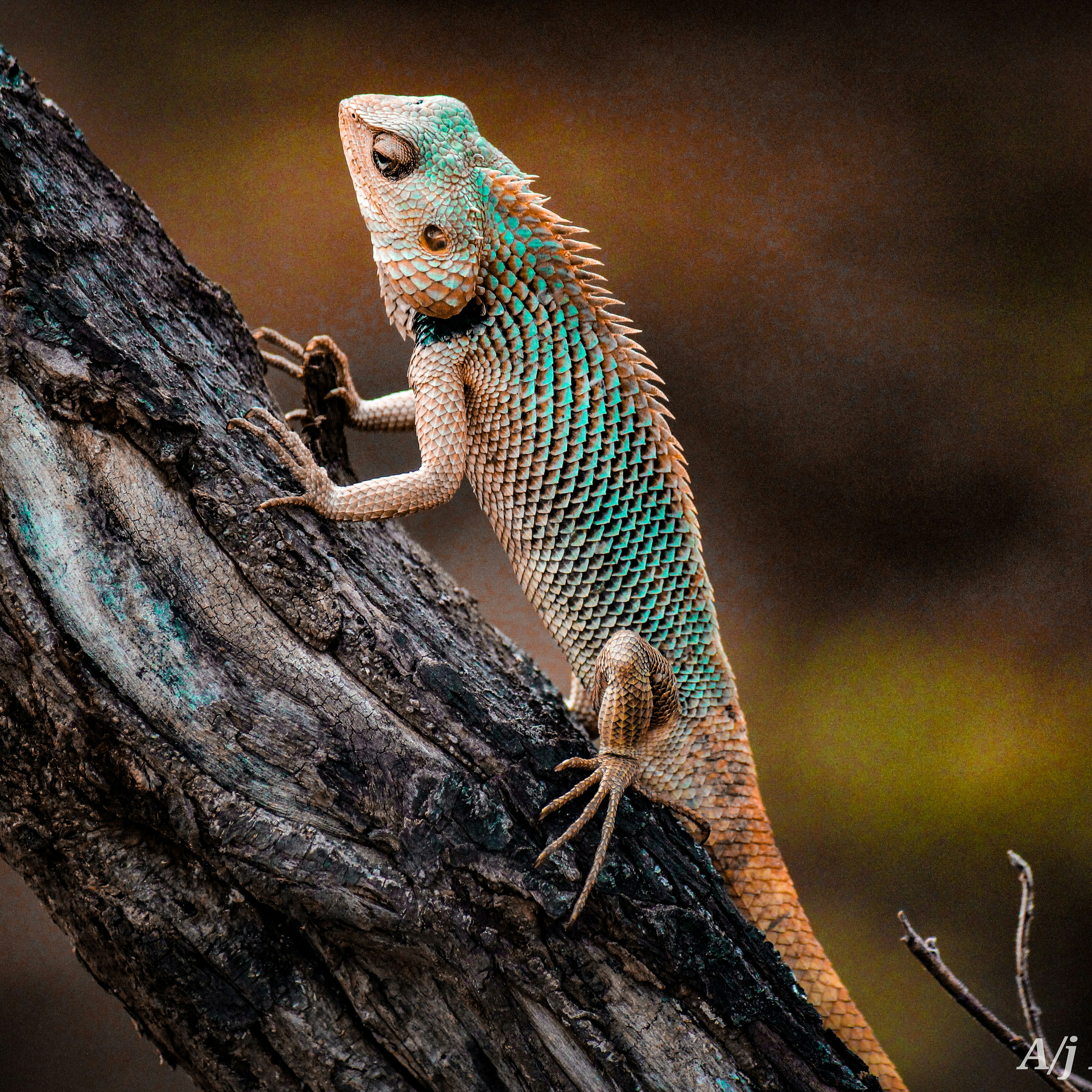
Keep On, You Lizard!
By Regan Calmer
I am the midnight lizard
The long black leathery iguana
At first sun I slither out from under
The red and yellow mangrove flower
Onto the flat cement wall beneath
The pedestrian bridge
Content to be warmed by the
Increasing heat of the Florida sun
At most I blink and shudder
Breathe in the rank swamp gas
It seethes sweetly through my
Cold, primordial veins and if
You look closely you might be
Amused by my wry, reptilian smile –
I know nothing but dread contentment
And am already sensing the big insects
As they hop around in their innocence
I am infinitely patient but it will
Not be long before I pounce, my
Disgusting elastic tongue, the
Weapon of many empty centuries
Snapping ecstatic to trap and swallow
Them whole as their exoskeletal limbs
Writhe slowly through the throes of death
But there you go you intruders
You clumsy humans you’ve gathered
To gawk at and shame me and my
Unholy brethren; we take offense and
Slip quickly back into our darkness:
We were warm enough now anyway
And can wait indeed another year or two
Until you and your unkind are gone for good.
Look at me, hiding from the likes of you…
Biography
Regan Calmer is a poet developing his craft in Queens, NY.
In Recent Poems
By Frederick Pollack
Despite the current, foolish, decadent
cult of self-advertisement,
the point of poetry for poet or reader
is a place to lie low.
As if with mental Lego blocks,
I constructed a harbor.
As in Marseilles and Helsinki,
a fortress looms.
From Baltimore I borrowed
a somber monolith which, amusingly,
refines sugar.
Hills, as in Lisbon and Long Beach.
The port itself containerized and automated;
the sea fenced off but still a presence
as it is sometimes in Manhattan
and will be more when Manhattan drowns.
The Mob, as is often the case,
runs dockside restaurants, owns
the buildings, so that there’s little street crime
(they don’t tolerate nonsense),
and the viewless apartments up side streets
are a good place to disappear.
At the end, you know, you’ll be allowed
no dignity or privacy,
whether by torturers, nurses,
or reluctantly involved passersby.
Biography
Frederick Pollack is the author of two book-length narrative poems, The Adventure (Story Line Press, 1986, reissued 2022 by Red Hen Press) and Happiness (Story Line Press, 1998), and three collections, A Poverty of Words (Prolific Press, 2015), Landscape with Mutant (Smokestack Books, 2018), and The Beautiful Losses (Better Than Starbucks Books, 2023). In print, Pollack’s work has appeared in Hudson Review, Salmagundi, Poetry Salzburg Review, Manhattan Review, Skidrow Penthouse, Main Street Rag, Miramar, Chicago Quarterly, The Fish Anthology (Ireland), Poetry Quarterly Review, Magma (UK), Neon (UK), Orbis (UK), and elsewhere. Online, his poems have appeared in Big Bridge, Diagram, BlazeVox, Mudlark, Occupoetry, Faircloth Review, Triggerfish, and elsewhere. Website: www.frederickpollack.com.
Death to Self
By Ann Marie Potter
How was it, all those years
Seven? Ten? A lifetime?
the preachers said,
“You must die to yourself!”
and I nodded my head
and tried, really tried,
to comply.
Desires: Denied.
Opinions: Squashed.
Emotions: Abort! Abort!
Finally, I succeeded.
My self lay on the floor
Dirty linoleum cluttered with
cat hair and clippings
of nails ripped to the quick.
My self, a fetus, wet
with blood and the warm, salty water
of miscarriage.
It barely breathed, moved
in tiny shudders, made the
sounds of the badly wounded
but not quite dead.
The preachers smiled warmly
I’d won their love. Almost.
Kill it! Finish it off!
And you will have a place
among us.
I looked at them and the prize
They offered; the acceptance
of a father,
friendship of a brother,
the wink of an eye and
nod of a chin that said
I’d finally gotten it right.
Then I looked at my self
saw her convulse
heard her whimper
for want of mercy.
I guess I’m a sucker
for little, bloody things.
Perhaps that makes me weak
But I picked her up,
cleaned her, held her
warm to my chest.
Too late now-I love her.
She grows and coos
and smiles one tooth
smiles.
She’s got tiny feet
and she’s learned
to chortle at
Scooby Doo.
She trusts me.
I will never cut
the giggles from
her throat with
the dull knife
of religion.
Never watch her brown eyes
widen in shock and terror
Never hear betrayal break
her fast beating, baby heart.
I will never sacrifice
her to anyone
Not to the preachers who shake
their heads like disappointed
grandfathers.
Not to anyone.
Not even to God
Biography
Ann Marie Potter is in her last year of a PhD program at Oklahoma State University while enjoying her first year in the beautiful state of Wyoming. Her work has been published in The Storyteller, The Meadow, Peauxdunque Review, and Literally Stories.
An Indian shoots a wounded deer in the heart
By Mykyta Ryzhykh
An Indian shoots a wounded deer in the heart
I stumble over a stone and don’t notice the stream of blood in my chest
The aroma of iron saturates the innocent grass
The Indian picks me up and carries me to his basement
What will happen to me next in this basement?
I ask myself this but no one answers
The crackling of wood in the fireplace wakes me from sleep
Again I wake up alone in my room
The Indian named fire falls asleep
I go out into the morning street and everything around is dark
Biography
Winner of the international competition Art Against Drugs and Ukrainian contests Vytoky, Shoduarivska Altanka, Khortytsky dzvony; laureate of the literary competition named after Tyutyunnik, Lyceum, Twelve, named after Dragomoshchenko. Nominated for Pushcart Prize. Published many times in the journals Dzvin, Dnipro, Bukovinian magazine, Polutona, Rechport, Topos, Articulation, Formaslov, Literature Factory, Literary Chernihiv, Tipton Poetry Journal, Stone Poetry Journal, Divot journal, dyst journal, Superpresent Magazine, Allegro Poetry Magazine, Alternate Route, Better Than Starbucks Poetry & Fiction Journal, Littoral Press, Book of Matches, on the portals Litсentr, Ice Floe Press and Soloneba, in the Ukrainian literary newspaper.